If your dental practice is losing two appointments a day to no-shows, you are not just losing time. You are losing payroll, chair utilization, and growth. Most owners underestimate the cost of dental no-shows by a factor of two or three because they only count the obvious number: the missed fee. The real number includes hygienist wages, assistant time, fixed overhead, and the opportunity cost of a patient who could have filled that slot.
This deep dive walks through a realistic cost model for a three-chair clinic, unpacks the five genuine reasons patients miss appointments, and lays out a 12-point, 90-day plan you can run alongside your existing systems. If you are looking for a practical companion read, our 10 ways to reduce patient no-shows article covers the tactical side; this article focuses on the economics and the roadmap.
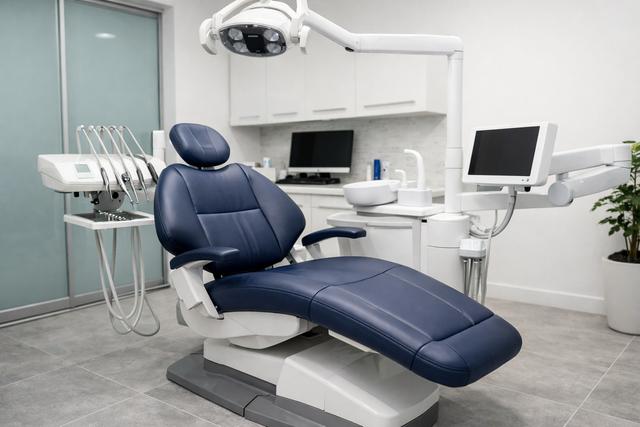
How much does a single dental no-show actually cost you?
Start with a simple model. Assume your chair produces $180 of revenue per hour on average across hygiene and restorative mix. A one-hour no-show with no fill means you lose the full $180 of revenue. But the chair does not turn off.
Your hygienist is still being paid — call that $35 to $45 for that hour. Your assistant is still on the clock at $22 to $28. Your rent, insurance, software, utilities, and loan payments do not pause — allocate another $30 to $40 of fixed overhead per chair-hour. So the hour you thought cost you $180 actually drained closer to $270 once you count the wages and overhead that did not stop.
Multiply that by a typical no-show rate of 10 to 15 percent across a 40-hour week and you are looking at $1,000 to $1,600 of weekly loss per chair. In a three-chair practice, that is $150,000 to $250,000 of annualized erosion. That is not a rounding error. That is the difference between hiring another hygienist and not.
And this model does not include the long-tail cost: patients who no-show once are meaningfully more likely to drop off the recall list entirely, meaning you also lose the lifetime value of future hygiene visits and referrals.
Why patients no-show: the 5 real reasons
If you want to fix no-shows, you have to stop treating them as one problem. They are five different problems wearing the same costume. Here they are, in rough order of frequency:
- "It wasn't on my calendar." The appointment was booked six months ago at the last hygiene visit. It never made it into Google Calendar. The patient genuinely did not know today was the day.
- "I forgot." It was on the calendar but life got loud. A child is sick, a meeting moved, and the 9:30 slot is behind them before they realize.
- "I'm scared." Dental anxiety affects roughly one in three adults. The closer the appointment gets, the more the patient rationalizes a reason to cancel.
- "I couldn't get off work." Shift workers, single parents, and hourly employees are not skipping out — they literally cannot leave. If you do not offer evening or Saturday slots, this is a structural problem.
- "I feel fine." Asymptomatic patients — especially for hygiene recalls — convince themselves they do not need to come in. This one correlates strongly with longer recall intervals.
Each reason wants a different fix. A reminder solves reason 1 and 2 but does nothing for reason 3. A deposit policy addresses reason 2 and 5 but alienates reason 4 patients. This is why a single-tool approach always underperforms.

The fix #1 — Multi-channel reminder stack
Single-channel reminders have a ceiling. SMS open rates are about 98 percent but reply rates are low. Email has great deliverability for confirmations but 40 to 60 percent of reminders never get opened. WhatsApp has 98 percent open rates and 40 percent reply rates but is not universal in the US or UK. Phone calls work for elderly patients but do not scale.
The answer is a stacked reminder cadence, not a choice between channels. A proven cadence looks like:
- One week out: Email confirmation with the appointment details, map, and a one-click reschedule link.
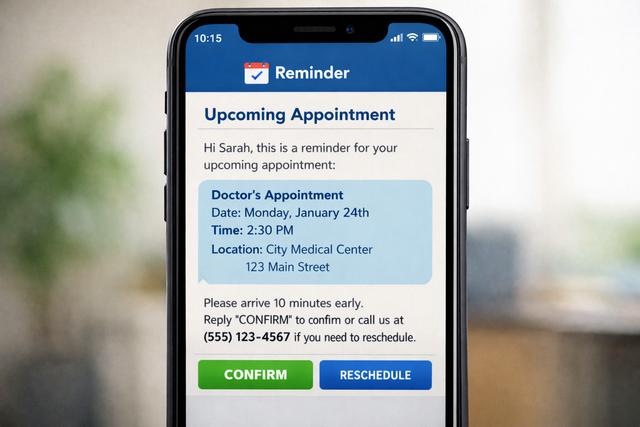
- Two days out: WhatsApp message (or SMS fallback) with a "Reply YES to confirm, or tap here to reschedule" prompt.
- Two hours out: SMS with the provider's name and the chair-side arrival instructions.
Each message reinforces the last, and each uses the channel that handles a different slice of the failure modes. Our SMS appointment reminders implements this cadence by default, and the setup takes under 30 minutes. If you want the exact step-by-step, our how to send reminders guide covers the operational details.
The fix #2 — Two-way confirmations and auto-recall
A reminder that only broadcasts is half a system. The other half is capturing the signal — did the patient confirm, cancel, or go silent — and acting on it immediately.
When a patient replies "cancel" at 48 hours, you have two business days to fill that slot. A good system sends an auto-recall message to patients on your short-notice list ("A slot just opened Thursday at 10am — reply YES to grab it"). Done well, this turns a 15 percent raw no-show rate into a 4 to 6 percent net empty-chair rate.
The operational key is that the recall message goes out automatically within minutes of the cancellation, not hours. By the time your front desk manually notices and calls around, the moment has passed.
The fix #3 — Deposit and cancellation policies that work
Deposit policies are controversial because they feel unfriendly. But the behavioral science is clear: patients who have committed something — even a $25 hold — show up at dramatically higher rates than patients who have committed nothing.
The trick is framing. Do not call it a "no-show fee." Call it a "slot hold" that is fully credited to the visit. Apply it only to new patients and to patients who have previously no-showed twice. Waive it for emergency cases. Communicate it in the confirmation message so there is no surprise.
Practices that introduce a $25 to $50 slot hold on second-time offenders typically see that cohort's no-show rate drop from 25 to 30 percent down to 8 to 10 percent within two months. That alone pays for a year of reminder software.
The fix #4 — Handling the "fear and anxiety" no-show driver
Reminders, deposits, and recall systems do nothing for the patient hiding from their 9am filling because they are terrified. For this group, the intervention happens before the reminder even goes out.
Three tactics work well:
- Pre-visit video from the dentist. A 30-second clip — "Hi, I'm Dr. Chen, I'll see you Thursday, here's what we'll do" — removes the unknown. Attach it to the 48-hour reminder.
- Testimonial snippets. Include a one-line quote from a patient who had a similar procedure, embedded in the reminder email.
- "What to expect" PDF. For any procedure more intense than a cleaning, send a one-page explainer 72 hours before. It reduces anxiety-driven cancellations by roughly one-third.
Anxious patients do not need to be convinced; they need to be informed. Informed patients show up.
A 90-day no-show reduction roadmap
Here is a concrete 12-point plan you can run across three months. The point is that you do not have to do everything at once — you sequence it so each fix has time to show up in the data before you layer the next one.
Weeks 1–2: Measure.
- Pull 90 days of appointment data. Calculate your raw no-show rate, broken down by new vs existing patients, by provider, and by day-of-week.
- Identify your top 20 percent most-no-showing patients. This list matters later.
Weeks 3–4: Baseline reminders.
- Turn on a three-touch reminder stack (email at 7 days, WhatsApp/SMS at 48 hours, SMS at 2 hours).
- Make sure each reminder has a one-click reschedule link — friction kills confirmations.
Weeks 5–6: Two-way and auto-recall.
- Enable reply parsing so "cancel" triggers an immediate auto-recall message to your short-notice list.
- Build the short-notice list from patients who have explicitly opted in during intake.
Weeks 7–8: Policy.
- Add a slot-hold policy for new patients and repeat offenders. Communicate it in writing and in the confirmation message.
- Update your cancellation policy to require 24-hour notice.
Weeks 9–10: Anxiety interventions.
- Record a 30-second intro video for each provider. Attach to the 48-hour reminder.
- Create a "what to expect" one-pager for your top five procedures.
Weeks 11–12: Measure and iterate.
- Re-run the analysis from week 1. Expect a 40 to 60 percent reduction in no-show rate. If you are not seeing it, the failure is almost always in step 3 (reminder deliverability) or step 5 (auto-recall speed).
- Replace any remaining 10 percent no-show slots with your short-notice list by making it easier to opt into short-notice alerts — add a checkbox to your intake form and promote it on your booking page.
If your practice is simultaneously struggling to grow the patient base, pair this plan with our how to attract new patients article so the slots you save from no-shows get filled with growth. For a longer proof point, our reducing no-shows by 80% case study walks through a three-chair clinic that ran this exact roadmap.
Where DodoDentist fits in
DodoDentist is built around this playbook. The multi-channel reminder stack, two-way parsing, auto-recall from your short-notice list, and slot-hold policies are all first-class features — not bolted-on integrations. You bring your patient list; we bring the rails that make the 90-day plan runnable without hiring a dedicated recall coordinator.
You get:
- WhatsApp Business API reminders with automatic SMS fallback for patients without WhatsApp
- Reply parsing so cancels trigger instant recall messages to your short-notice list
- Configurable cadence per provider and per appointment type
- A single dashboard for no-show rate, confirmation rate, and recall fill rate
If you want to skip the vendor comparison grind, the short version is: dedicated reminder software pays for itself in the first month for most practices running more than two chairs.
See how DodoDentist cuts no-shows — start a free trial.