Patient no-shows are one of the most frustrating and costly problems in dentistry. Every missed appointment means lost revenue, wasted chair time, and a gap in care for the patient. Studies consistently show that dental practices experience no-show rates between 10 and 30 percent, and for some clinics, the number is even higher. Understanding the real cost of dental no-shows is the first step to solving them.
The good news is that most no-shows are preventable. With the right systems and strategies in place, you can significantly reduce missed appointments and keep your schedule running smoothly. Modern SMS appointment reminders automate most of the tactics below. Here are ten proven ways to do it.
Dental No-Show Rate Benchmarks
| Practice profile | No-show rate | |---|---| | Industry average | 10–30% | | Practices without automated reminders | up to 50% | | Well-managed practices | 5–10% | | Top-tier practices (automated reminders + waitlist) | under 5% |
The 10–30% industry benchmark is cited by the American Dental Association and multiple peer-reviewed practice-management studies. The gap between average and top-tier practices comes down to one thing: systems.
1. Send Automated Appointment Reminders
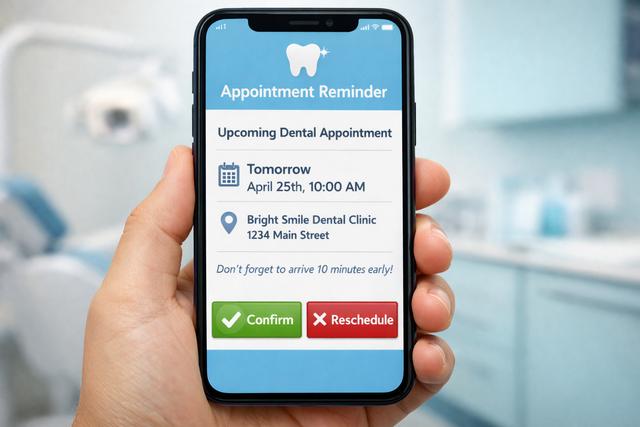
The single most effective way to reduce no-shows is to remind patients about their upcoming appointments — automatically and repeatedly.
Manual phone calls are time-consuming and unreliable. Automated reminders sent via SMS, WhatsApp, and email reach patients on the platforms they actually use, without adding work for your front desk team. Automated SMS reminders are the most reliable starting channel in most countries.
Best practices for reminders
- Send the first reminder 48 hours before the appointment.
- Send a second reminder the morning of the appointment.
- Include the date, time, location, and provider name in every message.
- Add a one-tap confirmation link so patients can confirm or request to reschedule.
Reach patients on WhatsApp
In countries where messaging apps are more popular than SMS, WhatsApp appointment reminders see open rates above 95 percent and reply rates far higher than text — especially with multilingual patient bases.
Dental practice management tools like DodoDentist automate this entire process — sending multi-channel reminders on a customizable schedule so nothing falls through the cracks. For a deeper dive, read our complete guide to dental practice management software.
2. Offer Online Booking and Rescheduling

Patients who can easily manage their own appointments are far less likely to no-show. When rescheduling requires a phone call during business hours, many patients simply do not bother — they just skip the appointment.
Provide patients with:
- An online booking page where they can choose a time that works for them.
- A rescheduling link in every reminder message.
- The ability to cancel or reschedule up until a reasonable cutoff time.
Making it easy to reschedule converts potential no-shows into rebooked appointments.
3. Implement a Clear Cancellation Policy
Every practice should have a cancellation policy — and patients should know about it from day one.
Elements of an effective policy
- Require 24 to 48 hours notice for cancellations.
- Communicate the policy at the first visit, on your website, and in appointment confirmations.
- Consider a cancellation fee for repeated no-shows (and enforce it consistently).
- Frame it positively: "We reserve this time exclusively for you, and advance notice allows us to offer the slot to another patient."
The goal is not to punish patients but to create accountability. Most patients will respect the policy once they understand it.
4. Confirm Appointments in Advance
There is a difference between a reminder and a confirmation. Reminders inform patients about an upcoming appointment. Confirmations ask them to actively acknowledge that they will attend.
When you send a confirmation request and a patient does not respond, that is a strong signal that they may not show up. You can then:
- Follow up with a phone call.
- Offer the time slot to a waitlisted patient.
- Proactively reschedule.
Two-way confirmation turns passive reminders into actionable communication.
5. Reduce Wait Times Between Booking and Appointment
The longer the gap between when a patient books and when their appointment is scheduled, the more likely they are to no-show. Life gets in the way, priorities shift, and the appointment feels less urgent.
How to shorten the gap
- Offer same-week or next-day availability for routine appointments.
- Keep a waitlist so you can fill cancellations quickly.
- Avoid booking too far in advance unless the procedure requires it.
If a long wait is unavoidable, increase the number of reminders leading up to the appointment.
6. Send Pre-Appointment Instructions
Patients are more likely to show up when they feel prepared and know what to expect. A brief message before their appointment can make a big difference.
Include details like:
- What to bring: insurance card, ID, completed forms.
- What to expect: a brief description of the procedure or visit.
- Parking and directions: especially for new patients visiting for the first time.
- Estimated duration: so they can plan their day accordingly.
This small touch shows that you value their time and reduces anxiety, particularly for patients who feel nervous about dental visits.
7. Build Stronger Patient Relationships
Patients who feel connected to their dentist and the practice team are far less likely to skip appointments. Relationship-building starts at the first interaction and continues with every visit.
Ways to strengthen relationships
- Greet patients by name and remember personal details.
- Follow up after procedures with a quick phone call or message to check on their recovery.
- Create a welcoming environment — comfortable waiting areas, friendly staff, and minimal wait times.
- Be transparent about treatment plans, costs, and what to expect.
When patients trust and like their dental team, keeping appointments feels important rather than optional.
8. Use a Waitlist to Fill Gaps
Even with the best prevention strategies, some cancellations and no-shows will happen. A waitlist ensures those open slots do not go to waste.
How to manage a waitlist effectively
- When patients call and your schedule is full, offer to add them to the waitlist.
- When a cancellation occurs, automatically notify waitlisted patients with a first-come-first-served offer.
- Use automated notifications so your staff does not have to make manual calls.
A well-managed waitlist keeps your chairs full and reduces the financial impact of last-minute cancellations.
9. Address the Root Causes
Not all no-shows happen for the same reason. Understanding why your patients miss appointments helps you tailor your response.
Common reasons and solutions
- Forgetfulness — solved by automated reminders and confirmations.
- Fear or anxiety — address with gentle communication, sedation options, and a comforting environment.
- Cost concerns — offer transparent pricing, payment plans, and discuss insurance coverage upfront.
- Transportation issues — provide clear directions and parking information; consider telehealth for consultations that do not require in-person care.
- Scheduling conflicts — offer flexible hours, including early morning, evening, or weekend slots.
Ask patients who miss appointments why they did not make it. The answers will reveal patterns you can address systematically.
10. Track and Analyze Your No-Show Data
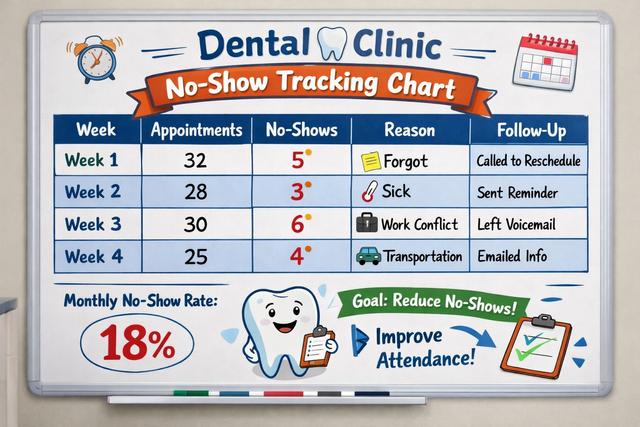
You cannot improve what you do not measure. Track your no-show rate over time and look for patterns.
What to track
- Overall no-show rate per week and per month.
- No-show rate by day of week and time of day — you may find that certain slots have higher no-show rates.
- No-show rate by appointment type — new patient visits, cleanings, and procedures may have different patterns.
- Repeat offenders — identify patients who regularly miss appointments and address the pattern directly.
Use your practice management software to generate reports and review them monthly. Set a target no-show rate and track your progress toward it.
How to Stop Dental Office Cancellations
The fastest way to stop cancellations is to remove friction on both sides of the appointment. Late cancellations typically come from one of three root causes: forgetfulness, inconvenience, or fear. Address all three:
- Send two reminders — 48 hours before and the morning of the appointment.
- Include a one-tap reschedule link in every reminder — convert cancellations into rebookings instead of losing the slot.
- Require advance notice (24–48 hours) in your written cancellation policy.
- Charge a small cancellation fee for repeat offenders (under $25 is usually enough).
- Offer flexible hours — early morning, evening, and Saturday slots eliminate "I couldn't get time off work" cancellations.
Practices that enforce these five rules typically see cancellation rates drop by 60–70 percent within 90 days.
How to Minimize No-Shows in Your Dental Practice
To minimize no-shows sustainably, build a system — not a tactic. A single reminder campaign will not cut it. The practices with sub-5% no-show rates all share four habits:
- Multi-channel reminders: SMS + WhatsApp + email, not just one channel.
- Two-way confirmation: patients must actively tap "Confirm" — silent patients get a follow-up call.
- Short booking-to-appointment windows: routine visits scheduled within 14 days.
- Monthly no-show review: track by day, time, appointment type, and provider — fix the outliers.
Tools like DodoDentist automate all four so your front desk can focus on patients in the chair.
Putting It All Together
Reducing no-shows is not about implementing one magic solution — it is about building a system of overlapping strategies that work together.
Here is a practical action plan:
- Start with automated reminders — this alone can cut no-shows by 30 percent or more.
- Enable online booking and rescheduling so patients can manage their appointments easily.
- Implement and communicate a cancellation policy to create accountability.
- Use confirmations to identify at-risk appointments before they become no-shows.
- Maintain a waitlist to fill gaps quickly when cancellations do occur.
- Track your data monthly and adjust your approach based on what the numbers tell you.
For a real-world example, see a 3-chair clinic case study that cut no-shows from 22% to 4.3% in 90 days.
The financial impact is significant. Fewer no-shows also means more opportunities to attract new patients by filling your schedule efficiently. If your practice sees 20 patients a day and reduces your no-show rate from 15 percent to 5 percent, that is two additional patients per day — potentially hundreds of thousands of dollars in recovered revenue per year.
Frequently Asked Questions
What is the average dental appointment no-show rate?
The average dental no-show rate is 10 to 30 percent, according to multiple industry studies. Well-run practices with automated reminders and a waitlist typically operate under 5 percent. Practices that rely on manual phone calls — or send no reminders at all — can see no-show rates above 40 percent.
How can dental practices reduce patient no-shows?
The most effective strategies are (1) automated SMS and WhatsApp reminders sent 48 hours before and again the morning of the appointment, (2) one-tap online rescheduling, (3) a clearly communicated cancellation policy, and (4) a waitlist that fills cancellations automatically. Together, these typically cut no-shows by 60 to 80 percent.
How do I stop dental office cancellations?
Stop cancellations by sending two reminders per appointment, including a reschedule link in every message, enforcing a 24–48 hour cancellation policy, and offering flexible hours for patients who struggle to take time off work. A small cancellation fee (under $25) for repeat offenders reinforces accountability.
How can I minimize no-shows in my dental practice?
Minimize no-shows by combining multi-channel reminders (SMS, WhatsApp, email), two-way confirmation, short booking-to-appointment windows, and monthly no-show data reviews. Practices with sub-5% no-show rates consistently use all four — not just one.
What is a reasonable dental cancellation fee?
Most practices charge between $25 and $75 for late cancellations (less than 24 hours' notice) or missed appointments, with the higher end reserved for longer procedures. The goal is accountability, not revenue — keep it proportional to the inconvenience caused.
How many dental appointment reminders should I send?
Two reminders is the sweet spot: one 48 hours before the appointment (so the patient can reschedule if needed) and one on the morning of the appointment. A third reminder often feels annoying and reduces response rates.
The Bottom Line
Patient no-shows are a solvable problem. With automated reminders, easy scheduling tools, clear policies, and a data-driven approach, you can dramatically reduce missed appointments and run a more efficient, more profitable dental practice.
The key is to make it easy for patients to remember, confirm, and show up — and to have systems in place to fill the gaps when they do not. Strong patient relationships start with a great reputation — learn how to build a 5-star online reputation for your practice.