If you send appointment reminders to patients by SMS or WhatsApp, you are processing protected health information (PHI) — even if the message just says "Don't forget your appointment tomorrow at 10." Regulators on both sides of the Atlantic take this seriously, and the fines for getting it wrong have moved past the symbolic into the genuinely painful.
The good news: compliant reminders are not complicated once you know the rules. This guide walks through HIPAA, GDPR, TCPA, LGPD and PIPEDA as they apply to SMS appointment reminders and WhatsApp appointment reminders for dentists, and gives you a template you can copy into your SMS appointment reminders today.
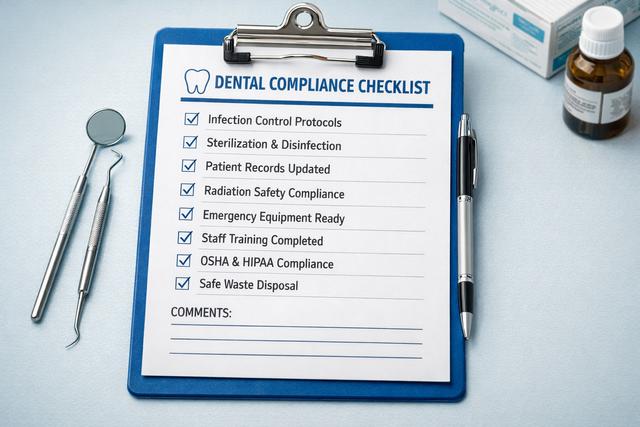
The compliance map: HIPAA, GDPR, LGPD and PIPEDA
Before looking at SMS and WhatsApp specifically, know which rulebook applies to you. Jurisdiction follows the patient, not the clinic — so if you treat a US resident in Paris or an EU citizen in Miami, both frameworks can apply.
- HIPAA (United States) — The Health Insurance Portability and Accountability Act governs PHI for any "covered entity" (dental practices included) and their "business associates" (your reminder vendor). It sets a national floor; state laws can add on top.
- GDPR (European Union / UK) — Treats any information linking an identifiable patient to a health service as a "special category" of data. You need both a lawful basis (Article 6) and a specific condition for processing health data (Article 9).
- LGPD (Brazil) — Modeled closely on GDPR but with its own regulator (ANPD). Consent and legitimate interest are the usual bases; explicit consent is required for sensitive health data.
- PIPEDA (Canada) — Federal private-sector privacy law. Quebec, Alberta and BC have equivalent provincial statutes that apply in place of PIPEDA. All require knowledge-and-consent for collection and disclosure.
If you operate a multi-location practice that touches more than one of these, build to the strictest standard that applies — usually GDPR plus HIPAA — and you will comfortably satisfy the rest.
HIPAA and SMS: the PHI minimization rule
HIPAA permits appointment reminders by SMS. What it does not permit is leaking more PHI than the communication strictly requires. This is known as the minimum necessary standard, and it is where most clinics trip up.
What you can typically include in an SMS reminder:
- Patient's first name or initials
- Clinic name
- Appointment date and time
- A way to confirm, reschedule or cancel
- A non-clinical reason like "follow-up" (generally fine)
What you should not include:
- The specific treatment or procedure ("root canal follow-up", "implant consultation")
- Insurance, billing or payment balances
- Lab results, diagnoses or imaging references
- Full date of birth or government ID numbers
The Office for Civil Rights has not fined a clinic for saying "See you tomorrow at 3" — it has fined clinics for sending "Reminder: your hepatitis C treatment appointment." Keep it boring.
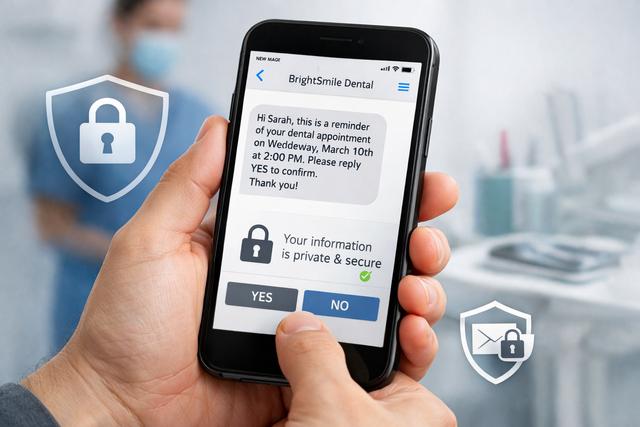
The BAA — why it is non-negotiable
Any third party that transmits, stores or processes PHI on your behalf is a Business Associate under HIPAA, and you must have a signed Business Associate Agreement (BAA) with them before going live. No BAA = automatic violation, regardless of whether a breach ever occurs.
When evaluating a reminder vendor, look for:
- A BAA offered by default on the plan you are paying for — not as a paid upgrade, and not only on enterprise tiers.
- Encryption in transit (TLS 1.2+) and at rest (AES-256) documented in writing.
- US-based data residency if you are a US practice, or equivalent EU hosting for GDPR.
- Audit logs of every message sent, with who sent it and when.
- A published breach-notification SLA (HIPAA requires notification within 60 days; good vendors commit to 72 hours).
- Subprocessor transparency — you need the list of sub-vendors (SMS carriers, WhatsApp providers) and their own BAAs.
If a vendor says "we don't need a BAA because we don't store PHI," walk away. Transmitting PHI is processing PHI.
TCPA consent for US SMS — opt-in, STOP/HELP, audit trail
HIPAA handles the medical-privacy side. The Telephone Consumer Protection Act (TCPA) handles the consent-to-contact side — and it applies to every SMS you send to a US number, regardless of content. TCPA penalties are $500 to $1,500 per message, and class-action attorneys love it.
The four things you need:
- Express written consent captured before the first SMS. A checked box on your intake form with clear language ("I agree to receive appointment reminder SMS from [clinic]. Message and data rates may apply") is enough.
- STOP keyword handling — patient replies "STOP" and your system must suppress further non-transactional messages within 24 hours. Confirm the opt-out with one final message.
- HELP keyword handling — patient replies "HELP" and the system returns contact info and opt-out instructions.
- An auditable timestamp log showing when each patient consented, what exact language they agreed to, and the IP or channel used. When a TCPA complaint arrives 18 months later, this log is your entire defense.
Any serious reminder platform automates all four. If yours does not, fix that before anything else — the how to send reminders documentation shows the consent flow we recommend.
GDPR Article 6 legal basis for reminders in the EU
For EU and UK patients, GDPR requires a lawful basis for every processing activity. For appointment reminders there are two realistic candidates:
Legitimate interest (Article 6(1)(f)) — Once the patient has booked an appointment, the clinic has an obvious legitimate interest in reducing no-shows, and the patient reasonably expects a reminder. This is the basis most dental practices rely on for booking-confirmation and reminder texts.
Consent (Article 6(1)(a)) — Required for anything that goes beyond a reminder: marketing, recall campaigns, review requests, newsletters. The consent must be specific, granular, and as easy to withdraw as to give.
Two extra requirements for health data under Article 9:
- A Record of Processing Activities (Article 30) listing the reminder channel, retention period, recipients and lawful basis.
- A Data Protection Impact Assessment if you use profiling or automated decision-making (most standard reminder workflows do not trigger this, but cadence optimization might).
If your reminder vendor hosts patient data outside the EU, you also need Standard Contractual Clauses or an adequacy decision in place. A compliant vendor handles this for you.

WhatsApp and HIPAA: is it actually compliant?
This is the most common question we get. The honest answer: WhatsApp as a consumer app is not HIPAA-compliant, because Meta does not sign BAAs for WhatsApp. The WhatsApp Business API, accessed through a Meta-approved Business Solution Provider (BSP), is a different story.
When you send WhatsApp reminders through a BSP that is HIPAA-ready:
- The BSP signs a BAA with your practice.
- Messages flow through the official WhatsApp Business API (not the consumer app).
- You use pre-approved template messages for the reminder — freeform messaging is restricted to a 24-hour window after a patient replies.
- End-to-end encryption protects the message in transit.
- PHI minimization still applies — same rule as SMS.
DodoDentist's WhatsApp integration runs through the WhatsApp Business API, offers a BAA on US plans, and uses HIPAA-aware message templates out of the box. If your current workflow is "one staff member texting patients from their personal WhatsApp," that is a fineable violation — migrate before your next audit.
Data retention: how long to keep reminder logs
How long you keep the reminder log matters for two reasons: you need enough history to defend a TCPA or GDPR complaint, and you need to purge on time to satisfy data-minimization rules.
General guidance by jurisdiction:
- HIPAA — 6 years from creation or last effective date, federally. State dental boards may require longer (Texas is 5 years, New York 6, California 7 for adults and longer for minors). Default to the longer of state and federal.
- TCPA — Consent records for 4 years (the statute of limitations), but many attorneys recommend 5.
- GDPR / UK GDPR — No fixed period; keep "no longer than necessary." For reminders, 2 to 3 years post-last-appointment is defensible; pair with an annual purge job.
- LGPD — Similar to GDPR; document your retention decision in your processing record.
- PIPEDA — "As long as necessary" with a one-year minimum after the individual last used the service for any data that was used to make a decision about them.
Set the purge to run automatically. Manual purges do not happen, and a forgotten archive is exactly what regulators find first.
A compliance-ready reminder template you can copy today
Here is a template that satisfies HIPAA minimum necessary, TCPA disclosure, GDPR transparency, and still fits in a single SMS segment (160 characters):
"Hi [FirstName], this is [ClinicName] confirming your appointment on [Date] at [Time]. Reply C to confirm, R to reschedule. Reply STOP to opt out. HELP for info."
Notes on why each piece is there:
- First name only — enough to personalize without leaking full identity.
- Clinic name but no service type — preserves PHI minimization.
- Two-way confirmation — reduces no-shows without extra staff effort.
- STOP and HELP keywords — TCPA compliance baked in.
- Fits 160 characters — one SMS segment, lowest cost, highest deliverability.
For WhatsApp, the same text works as an approved utility template — just submit it for Meta review before going live.
Bringing it all together
Reminder compliance is not a one-time configuration. It is a discipline: consent captured at intake, minimum necessary PHI in every message, BAA and SCCs signed with vendors, audit logs retained, and a purge job that actually runs. Each piece is small; together they are the difference between a defensible program and a compliance incident.
If you are designing this from scratch, start with the complete guide to dental practice management software for the broader workflow, then drill into the channel-specific playbooks on how to send reminders. Both integrate with DodoDentist's built-in consent, opt-out and retention controls.
Download our 1-page HIPAA + TCPA reminder compliance checklist (free) — keep it next to the front desk and tick it off during your next quarterly privacy review.