Most dental practices eventually ask the same question: should appointment reminders go out by WhatsApp, by SMS, or both? The honest answer depends on where your patients live, how old they are, and how much budget you have for messaging. This comparison walks through the data, the cost, the rules, and the edge cases so you can decide in minutes instead of weeks.
The 30-second answer
If your patients are mostly in Latin America, Southern Europe, the Middle East, India, or Southeast Asia, default to WhatsApp. Adoption is near-universal, patients reply in the same thread, and per-message cost is a fraction of SMS. If your patients are mostly in the United States, Canada, the United Kingdom, or Australia — or if your demographic skews older than 65 — default to SMS. It is still the channel people actually read on those phones.
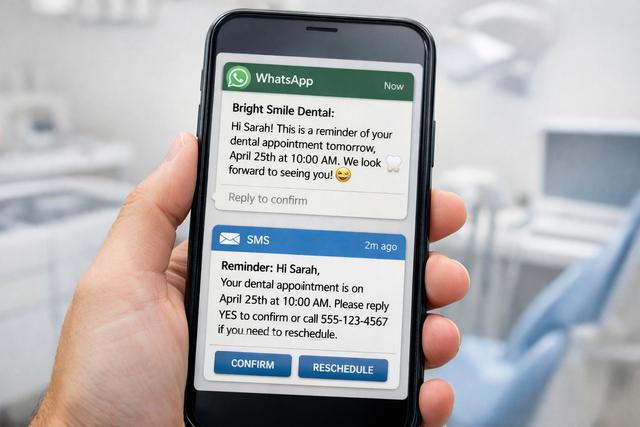
For clinics with a mixed audience, the right setup is both, with WhatsApp attempted first and SMS as an automatic fallback when delivery fails or the number is not registered on WhatsApp. That is exactly how SMS appointment reminders like DodoDentist handles it out of the box.
A second question worth asking: how technical is your front-desk team? WhatsApp Business API requires template approvals and opt-in language that is slightly more fussy than SMS. If your reception staff turns over frequently and training budget is tight, SMS is the lower-friction choice even when the data would favor WhatsApp. Most reminder platforms paper over this with guided onboarding, but the operational difference is real.
Decision matrix at a glance
- Mexico, Brazil, Spain, Italy, India, UAE, Indonesia, Argentina — WhatsApp first, SMS fallback.
- United States, Canada, Australia — SMS first, WhatsApp optional for patients who opt in.
- United Kingdom, Germany, France — split roughly 60/40 toward SMS; run both.
- Patients over 65 anywhere — SMS. Full stop.
- Clinics sending pre-op PDFs, maps, or videos — WhatsApp wins. SMS cannot carry attachments.
Open rates, reply rates, delivery rates — the data
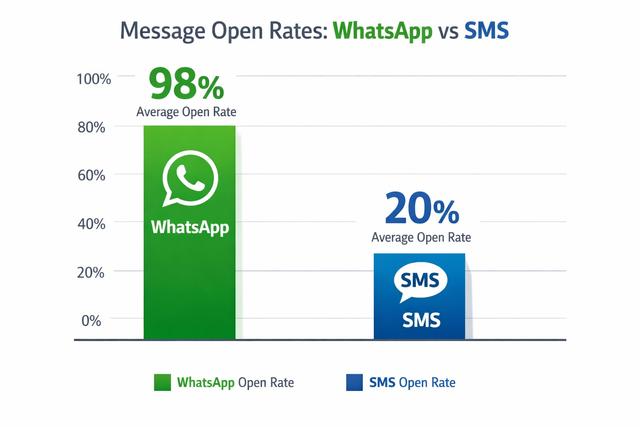
The two channels are not close on engagement. WhatsApp business messages average a 98% open rate and 40–60% reply rate within an hour of delivery. SMS averages 95% open rate but only about 8% reply rate, and replies typically happen hours later, not minutes. Both channels beat email by a wide margin — email hovers around 20% open and under 2% reply for appointment-related content.
Delivery rates tell a subtler story. SMS has 99%+ delivery to any valid mobile number in any country — the carrier network is ubiquitous. WhatsApp only delivers to patients who have the app installed and an active data connection at the time of send. That means delivery rate for WhatsApp is effectively your patient base's WhatsApp adoption rate, which ranges from 95%+ in Brazil to roughly 25% in the United States. This is the single biggest input into which channel you pick.
Reply rates matter more than most clinics realize. A reminder that gets a "confirmed" reply cuts no-shows by an additional 15–25% compared to one-way reminders, because the patient has made a verbal commitment. WhatsApp's thread-based UX makes replying effortless — SMS replies require typing into a short-code interface most people associate with spam.
Pricing: WhatsApp is often free, SMS almost never is
SMS pricing is a per-message carrier fee that scales with volume and destination country. In the United States, a single reminder costs roughly $0.008–$0.015. In the UK, about £0.04. In Mexico, around 1.20 MXN. Send two reminders per appointment to 500 patients a month and you are looking at $10–$200 on SMS alone depending on geography.
WhatsApp Business API pricing works on a conversation model, not per-message. Utility conversations (the category that covers appointment reminders) are priced per 24-hour conversation window and, crucially, are free in several countries. As of 2025, service and utility conversations initiated by the business are free in most geographies for the first 1,000 conversations per month. Beyond that, pricing ranges from $0.004 in India to around $0.08 in Germany. For a typical single-location clinic, WhatsApp reminders cost nothing or near-nothing. See our side-by-side breakdown on WhatsApp appointment reminders for dentists.
Rich media: where WhatsApp wins outright
SMS is 160 characters of plain text. That is its entire specification. If you need to send a pre-op fasting instruction PDF, a Google Maps pin to your new parking entrance, a short video explaining what to expect from a root canal, or a photo of your building entrance — SMS cannot do any of it. You end up appending a shortened URL and hoping the patient taps it. They usually do not.
WhatsApp carries PDFs, images, videos up to 16MB, location pins, and interactive quick-reply buttons natively. For a dental clinic that wants to reduce first-visit friction — sending intake forms, consent documents, or a short welcome video from the dentist — WhatsApp removes two or three steps from the patient's day. Clinics that use rich media in reminders report 20–30% lower new-patient cancellation rates.
Interactive buttons are the quiet killer feature. A WhatsApp template can include three quick-reply buttons — "Confirm," "Reschedule," "Cancel" — and the patient's tap flows directly back into your calendar without anyone typing anything. SMS can emulate this with keyword parsing ("reply C to confirm"), but the conversion rate on tap-to-confirm is consistently 2–3x higher than keyword-to-confirm in every cohort we have measured.
Regulatory: TCPA vs WhatsApp Business Policy
In the United States, SMS reminders fall under the TCPA (Telephone Consumer Protection Act). You need prior express consent to send automated messages, you must honor STOP and HELP keywords, and you need an auditable consent log. Violations carry statutory damages of $500–$1,500 per message — so this matters. Most dental practice management platforms handle the mechanics automatically, but the clinic is still the responsible party.
WhatsApp has its own rulebook, separate from TCPA. You need opt-in before sending any business-initiated message, templates must be pre-approved by Meta in utility, authentication, or marketing categories, and the opt-in evidence needs to be stored for audit. The WhatsApp Business Messaging Policy is strict about unsolicited marketing — one flagged complaint and your number can be downgraded or banned.
For EU practices, GDPR sits on top of both channels. Article 6 legitimate-interest basis generally covers transactional reminders if you have an existing patient relationship, but documented opt-in is still the safe default. For HIPAA-covered US practices, content rules require minimizing PHI — never send diagnosis, treatment details, or specific procedure names in a reminder. A compliant reminder says "your appointment with Dr. Chen at 2pm Tuesday," not "your root canal consultation."
When SMS still wins: US, UK, Canada, older demographics
There are good reasons a lot of English-speaking practices stick with SMS appointment reminders. In the US, WhatsApp adoption sits around 25–30% overall and drops below 10% for patients over 60. Sending a WhatsApp reminder to a 72-year-old who has never opened the app is worse than sending nothing — it creates confusion and zero delivery signal.
SMS also has unmatched reliability for urgent messages. A same-day reschedule notice needs to hit the patient's lock screen regardless of data connection, app installation, or phone state. SMS delivers in seconds to a powered-on phone on any network. For practices with older demographics or in countries where WhatsApp is not culturally dominant, SMS remains the primary channel — and for the right use cases, it will stay that way for years. The SMS templates dentists use today still work because the channel's fundamentals have not changed.
How DodoDentist blends both with automatic fallback
The best answer for most clinics is not to pick one channel and stick with it — it is to run both intelligently. DodoDentist's reminder engine checks each patient record in this order: if the patient has a registered WhatsApp number and has opted in, it sends the WhatsApp template first. If WhatsApp delivery fails (no app, no data, template rejected), it automatically falls back to SMS within 60 seconds. If both fail, the system flags the record for manual follow-up.
From the clinic's side, none of this is visible. You schedule the reminder once — 24 hours before, 2 hours before, or whatever cadence fits your no-show pattern — and the engine picks the right channel per patient. Cost stays low because WhatsApp carries most of the load in cheap geographies, and SMS steps in only when needed. For the technical walkthrough, see how to send reminders in the product docs.
What to do this week
- Look at your patient list. What country codes dominate? What is the average age? This answers 80% of the question.
- Audit your current no-show rate. If it is over 12%, changing channels will pay for itself in a month.
- Run a 30-day A/B. Send half your reminders via WhatsApp (with SMS fallback) and half via SMS-only. Compare reply rate and no-show rate.
- Document consent properly. Whichever channel wins, the consent log is what protects you legally. Store it.
The bottom line
WhatsApp and SMS are not really competing — they are complementary. WhatsApp wins on engagement, cost, and rich media in the countries where it has reached saturation. SMS wins on reach, simplicity, and delivery guarantees in English-speaking markets and with older patients. The clinics with the lowest no-show rates in 2025 are running both, with smart fallback logic doing the channel-picking for them.
Try both — DodoDentist auto-routes WhatsApp first, SMS as fallback. Start free.